
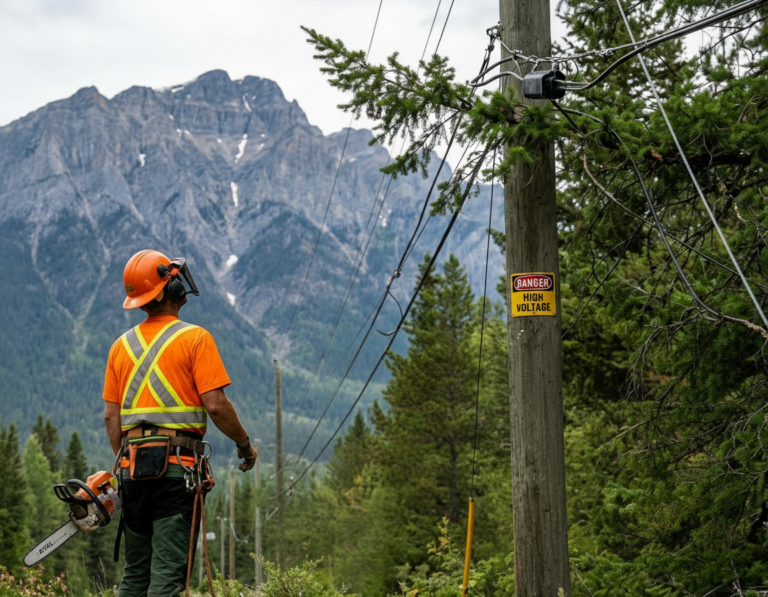
Living in the rugged beauty of the East Kootenays means sharing our properties with majestic larches, firs, and pines. However, when those trees meet power lines, the results can be catastrophic! ranging from localized outages to forest fires.
At Scott Wills Tree Service, we frequently get asked: “Does BC Hydro trim my trees, or is that on me?” The answer depends entirely on which wire the tree is touching.
This guide breaks down the legalities, safety requirements, and your specific responsibilities under BC Hydro and WorkSafeBC regulations.
Service Wires vs. Distribution Lines
To understand your responsibility, you first need to identify the type of line on your property.
- The Service Wire (Your Responsibility): This is the twisted line that runs from the BC Hydro pole directly to your house. According to BC Hydro’s vegetation maintenance guidelines, maintaining clearance for this wire is the homeowner’s responsibility.
- The Distribution Line (BC Hydro’s Responsibility): These are the high-voltage wires that run from pole to pole along the street. BC Hydro manages these through their proactive vegetation program.
If branches rub against your service wire, they can wear through the weather coating, leading to sparks, “dirty” power that damages home appliances, or a total service drop failure.
The “Plan for 10” Rule: WorkSafeBC Limits of Approach
Safety isn’t just a suggestion in BC; it’s the law. Under WorkSafeBC Occupational Health and Safety Regulation Part 19, there are strict “Limits of Approach.”
For most residential distribution lines (carrying up to 75,000 volts), you and your tools (ladders, pruners, etc.) must stay at least 3 meters (10 feet) away at all times.
Why 3 Meters?
Electricity can “arc” or jump through the air to a conductor—like a metal pole or a damp branch—without you ever touching the wire. If a tree on your property is within this 3-meter danger zone, do not attempt to trim it yourself. You are legally required to hire a Certified Utility Arborist (CUA) who is trained to work near energized equipment.
Planting for the Future: The 3-Zone System
The best way to avoid a dispute with BC Hydro (or a call to us for an emergency removal) is to plant the right tree in the right place. BC Hydro utilizes a 3-Zone System for distribution lines:
ZONE 1: Low Zone (Directly under the line)
-Only plant shrubs or small trees with a mature height of no more than 3 meters.
ZONE 2: Medium Zone (Within 5-10 meters of the pole)
Trees in this area should have a maximum mature height of 12 meters. (e.g., Japanese Maples or certain Dogwoods).
ZONE 3: Tall Zone (10+ meters from the pole)
Virtually any healthy tree is acceptable here, provided it won’t lean into the lines if it fails.
When to Call a Professional
If you notice any of the following, it is time to seek professional intervention:
- Sparking or Arcing: If you see “fireflies” in the branches during a windstorm.
- Encroachment: Any branch within 1 meter of your service wire.
- Hazard Trees: A dead or leaning tree outside the 3-meter zone that could fall onto the line (the “strike zone”).
Need a Safety Assessment? Our team at Scott Wills Tree Service provides professional certified utility arborist services to ensure your property remains compliant and your power stays on.